


Is it intrinsically antisemitic to call for a new political order between the Jordan River and the Mediterranean Sea — where the State of Israel currently reigns over 7.5 million Jews and 7.5 million Palestinian Muslims and Christians? By declaring anti-Zionism a form of antisemitism, that’s what Israel’s defenders want you to believe.
However, opposition to Zionism — the political philosophy focused on the establishment and maintenance of a separate nation-state for Jews — was itself pioneered by Jews a half-century before Israel’s founding. Going back to Zionism’s rise to prominence in the late 1800s, Jews have always been among this political ideology’s most ardent opponents. Revisiting early Jewish anti-Zionists’ arguments underscores just how absurd it is to equate opposition to an ethno-religious, nationalist political philosophy with bigotry.
While there were some earlier iterations, modern Zionism blossomed in 1897 with the publishing of The Jewish State (Der Judenstaat). In that political pamphlet, the Hungarian, Jewish journalist and lawyer Theodor Herzl argued that, after struggling in vain to assimilate in countries around the world, Jews should form their own nation-state to escape antisemitism.
Though modern Zionists’ definition of their movement emphasizes the Jewish homeland being located in the Levant, taking over territory in world Jewry’s purported “ancestral homeland” wasn’t always an essential dimension of the Zionist movement. In The Jewish State, Herzl nominated both Palestine and Argentina. “Argentina is one of the most fertile countries in the world, extends over a vast area, has a sparse population and a mild climate,” he wrote. “The Argentine Republic would derive considerable profit from the cession of a portion of its territory to us.” In 1903, Zionists considered a British government proposal to carve out thousands of square miles of territory in East Africa.
A year after publishing his history-altering pamphlet, Herzl organized the First Zionist Congress. Some 200 delegates from 17 countries convened in Basel, Switzerland, adopted a set of guiding principles, and created the World Zionist Organization to bring Herzl’s vision to life.
Significantly, Basel wasn’t Herzl’s first pick for the conference’s location. He wanted to host it in Munich or Vienna, but Jewish leaders in these and other cities across Europe wanted nothing to do with Zionism. The Executive Committee of the Union of Rabbis of Germany said the event would undermine Jews’ efforts to assimilate in German society, and mark them as members of a separate nation. They also objected on religious grounds, arguing that a Jewish state should be the result of God’s action and the eventual coming of the messiah.
In the run-up to the momentous Zionist congress, Vienna’s chief rabbi published a lengthy refutation of The Jewish State. “Judaism’s historical mission is not to support the centrifugal nationalist passions or fantasies of peoples, and even less to indulge in them itself, but rather to abolish the individualism of nations and work toward the union of all humanity into a single family,” wrote Rabbi Moritz Güdemann in a work titled National Judaism (Nationaljudenthum). “A Judaism armed with cannons and bayonets would reverse the roles of David and Goliath and be a parody of itself.”
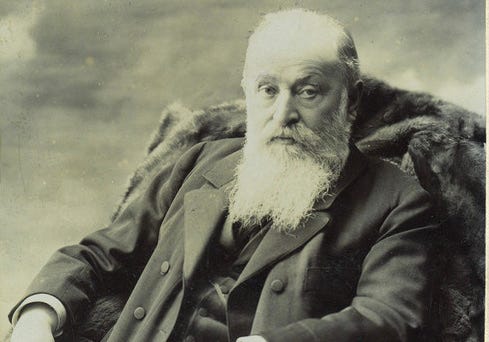
Secular Jews had their own reasons for opposing Zionism. Take, for example, the Jewish Labor Bund, a secular, socialist political party founded in 1897 in Tsarist eastern Europe, which called Zionism “the most evil enemy of the Jewish proletariat.”
“They felt that Zionism was a capitulation to the same bigots who wanted to kick Jews out of Europe,” Molly Crabapple, author of a book on the Bund — “Here Where We Live Is Our Country” — explained on Democracy Now. The Labor Bund also viewed Zionism as an immoral colonial project. “They thought it was the handmaiden of imperialism, and the Bundists scrupulously reported the brutality that has always marked Zionism — the expropriation of Palestinian land, the brutal evictions of Palestinian farmers, and the collaboration, hand-in-hand, with the British occupation,” Crabapple said.
Early Jewish anti-Zionism wasn’t confined to Europe. In 1897, the Central Conference of American Rabbis adopted a resolution against Zionism. “We affirm that the object of Judaism is not political or national, but spiritual, and addresses itself to the continuous growth of peace, justice and love in the human race,” the group declared. Striking similar chords in 1898, the Union of American Hebrew Congregations adopted its own resolution against Zionism:
“We are unalterably opposed to political Zionism. The Jews are not a nation, but a religious community. Zion was a precious possession of our past, the early home of our faith, where our prophets uttered their word-subduing thoughts and our psalmists sang their world-enchanting hymns. As such it is a holy memory, but it is not our hope in the future.
America is our Zion. Here, in the home of religious liberty, we have aided in founding this new Zion, the fruition of the beginning laid in the old. The mission of Judaism is spiritual, not political. Its aim is not to establish a State, but to spread the truths of religion and humanity throughout the world.”
In 1911, Rabbi Isaac Wise, founder of the Union of American Hebrew Congregations, said Jewish nationalism threatened to ruin Jews’ efforts to assimilate, telling the New York Times:
“We are men and patriots everywhere. Americans in America; Englishmen in England; Frenchmen in France; Germans in Germany, and so in all countries…after we have protested loudly and emphatically against any and every denial of our civic virtues, now come these Zionists and proclaim us as members of a foreign nation, one that has not existed, in fact, in nearly eighteen centuries.”
In the wake of World War I, as victorious allied leaders were poised to consider the political future of Palestine at the Paris Peace Conference, a group of dozens of prominent American Jews, led by California Republican Rep. Julius Kahn, presented a petition to President Wilson outlining their objections to Zionists’ demands for “the organization of a Jewish State in Palestine.”
The group of accomplished Jews attacked Zionism from many angles. They said the Zionist case “misinterprets the trend of the history of the Jews, who ceased to be a nation 2,000 years ago.” They said the proposition that all Jews around the world are part of a supposed Jewish nation would undermine Jews’ quest to assimilate in other countries, and would fan suspicions of dual loyalty. They pointed to the high risk of armed conflict resulting from the creation of a Jewish state in an area also populated by and revered by Muslims and Christians. They also condemned the idea of founding a new nation on the basis of Jewish race or religion, saying it was at odds with democratic ideals, and “would be a leap backward of 2,000 years.” They concluded by urging that Palestine instead become “a ‘land of promise’ for all races and creeds.”
One of the most pivotal events in the path to Israel’s creation came in 1917, with the UK government’s Balfour Declaration, which expressed the government’s support for a future “establishment in Palestine of a national home for the Jewish people.”
Edwin Samuel Montagu, the only Jew in the British cabinet at the time, vigorously opposed Zionism. “There is not a Jewish nation,” he said, warning that Zionism “must have the effect of stamping the Jews as strangers in their native lands.” He even said that British Zionists — by professing to be part of some separate Jewish nation — ought to lose their privilege to vote in UK elections. Scoffing at the idea of Jewish claims on land in the Levant, he wrote, “I deny that Palestine is today associated with the Jews.”
Montagu specifically assailed the Balfour Declaration as “a mischievous political creed.” In an August 1917 memorandum to the cabinet, he argued that a partition of Palestine to create a state for Jews would “prove a rallying ground for Anti-Semites in every country of the world,” and that “Jews will hereafter be treated as foreigners in every country but Palestine.”
In his opposition to Zionism, Montagu had plenty of prominent Jewish company in the UK, including David Alexander, president of the Board of British Jews, and Claude Montefiore, president of the Anglo-Jewish Association. “Jews in this country regard themselves primarily as a religious community,“ with “no separate national aspirations,” the two wrote in a letter published by The Times of London.
Albert Einstein — the most brilliant and prominent Jew of the 20th century — also resisted political Zionism, calling instead for a binational Palestine with open immigration, one that could serve as a cultural home for Jews but not a separate Jewish state.
“I would much rather see a reasonable agreement with the Arabs on the basis of living together than the creation of a Jewish State,” Einstein said. “A return to a nation in the political sense of the word would be the equivalent of turning away from the spiritualization of our community.”
In 1936, Einstein attacked the Zionist stance of the first Jewish US Supreme Court Justice, Louis Brandeis, who claimed that a secure Jewish future depended on “unification…..within a cohesive stretch of land.” Einstein countered that the Jewish community’s “durability” was actually enhanced by geographic dispersion. Offering an insight that rings especially true in 2026, Einstein said it was a good thing that Jews “do not possess instruments of power that will allow us to commit great stupidities out of national fanaticism.”

Einstein also highlighted the unjustness of imposing a Jewish state on a land where Jews were a minority. “It seems to me a matter for simple common sense that we cannot ask to be given the political rule over Palestine where two thirds of the population are not Jewish,” Einstein wrote. “It is difficult for me to grasp that our Zionists are taking such an intransigent position which can only impair our cause.”
In 1942, a group of US Reform Jews created the American Council for Judaism, making anti-Zionism one of its core tenets. In a 1943 debate with a Zionist, ACJ executive director Rabbi Elmer Berger told the audience:
“I oppose Zionism because I deny that Jews are a nation. We were a nation for perhaps 200 years in a history of 4,000 years. Before that we were a group of Semitic tribes whose only tenuous bond of unity was a national deity — a religious unity. After Solomon, we were never better than two nations, frequently at war with one another, disappearing at different times, leaving discernibly different cultures and even religions recorded in the biblical record.
Certainly, since the dispersion, we have not been a nation. We have belonged to every nation in the world. We have mixed our blood with all peoples. Jewish nationalism is a fabrication woven from the thinnest kinds of threads and strengthened only in those eras of human history in which reaction has been dominant and anti-Semitism in full cry.”
In December 1945, ACJ President Lessing Rosenwald met with President Truman in the Oval Office, urging that “Palestine [must] not be a Muslim, Christian or Jewish state but a country in which people of all faiths can play their full and equal part.” The next month, Rosenwald appeared before the Anglo-American Committee of Inquiry, a post-war body formed to assess the situation of displaced and persecuted European Jews, as well as conditions in Palestine relative to ongoing Jewish immigration. Rosenwald called for generous immigration of Jews to Palestine, but on an important condition: “The claim that Jews possess unlimited national rights to the land, and that the country shall take the form of a racial or theocratic state, [must be] denounced once and for all.”
Later, Rosenwald and Berger met with President Eisenhower, and presented a memorandum decrying the “confusion of Judaism with the nationalism of Israel,” and warning that Israel’s “Law of Return” — which offers citizenship to Jews all over the world — would have the effect of unilaterally imposing de facto Israeli citizenship on all Jews, exposing them to claims of dual loyalty, even if they personally opposed the creation of Israel in the first place.
Many Middle East Jews were quick to reject rising Zionism. Even before Israel’s founding in 1948, some of them felt Zionism was jeopardizing their amicable relationships with Muslims. Representatives of various Jewish populations of the region made that case to the Anglo-American Committee of Inquiry.
A year before Israel’s founding, Iraq’s chief rabbi, Sasson Khdouri, denounced Zionism:
“Jews and Arabs have enjoyed the same rights and privileges in Iraq for 1,000 years. Jews do not regard themselves as a distinctive part of this nation. The Zionist press had tried to create differences of opinion between Jews and Arabs, but I and every Iraqi Jew oppose and will fight such an aggressive attitude. Iraqi Jews are not Zionist and never will be.”
At the time, the Jewish Telegraphic Agency said Middle East governments were pressuring Jewish leaders to renounce Zionism. Some 20 years later, Khdouri was still voicing his opposition. “Zionism is a political movement which is not related to religion. Iraqi Jews have no link whatsoever with the Zionist movement,” he said.
Opposition to the creation of a Jewish state has long included Jews in what is now Israel, such as Rabbi Chaim Joseph Sonnenfeld, who emigrated to Palestine in the 1800s. “The Jewish people do not, under any consideration, desire to lay hands on that which is not theirs, and much less to touch any of the rights of the rest of the inhabitants to the places they have been holding and cherishing in respect and holiness,” he wrote in 1929. His outspokenness earned him some rough treatment at the hands of the Zionist Haganah paramilitary/terrorist organization.
Despite the long and rich history of Jewish anti-Zionism — which continues to unfold all around the world, to include within Israel itself — pro-Israel institutions, politicians and individuals routinely insist that anti-Zionism is inherently antisemitic. Put another way, they claim that anyone who criticizes the idea of a political entity created for Jews necessarily hates Jews, even if those critics are themselves Jews.
For example, the International Holocaust Remembrance Alliance (IHRA) Working Definition of Antisemitism says it’s antisemitic to “deny[] the Jewish people their right to self-determination.” Never mind that, for many Jews, there is no such thing as a “Jewish people” in a nationalist or ethnic sense — only individuals from around the world who share Judaism as a common religion. (As Vienna’s anti-Zionist Rabbi Güdemann put it in 1898, “Belief in one God is the unifying factor for Jews.”)
The IHRA also smears as antisemites anyone who merely argues that, by displacing millions of Palestinians and treating them in vastly different ways from Jews, the State of Israel is a racist endeavor. It’s one thing for Israel’s defenders to make a case that those people are wrong; it’s another to call them Jew-haters. This isn’t just about polite discourse: The IHRA definition is now being weaponized by governments around the world, with the false framework being incorporated into laws and regulations governing speech, expression and civil rights.
Applying a tight reading of the IHRA definition, a quarter of American Jews are antisemites. In a May poll by the Jewish Voters Resource Center, 24% of US Jews said the Israeli-Palestinian conflict would be best resolved by “establishing one state that is neither Jewish nor Palestinian, and includes Israel, the West Bank and Gaza under a single government elected by Israelis and Palestinians.”
Amid the spreading realization that aggressive Israeli settlement of the West Bank has rendered a two-state solution to the Israeli-Palestinian conflict a physical impossibility, and with the world increasingly disturbed by the trajectory and ambitions of the Israeli state, let’s not allow contemplation of a one-state solution to be chased to the margins of discourse by pro-Israel forces wielding a manifestly false definition of antisemitism.


For those wanting to delve deeper into pre-1948 Zionism and anti-Zionism, focusing primarily on the United States, I very much recommend "Against Our Better Judgment: The Hidden History of How the US Was Used to Create Israel," by Alison Weir. She's the creator of the website "If Americans Knew." I recently read her book and it inspired my latest article.
https://www.amazon.com/Against-Our-Better-Judgment-History/dp/149591092X
EXCELLENT article!